Neoclassicism

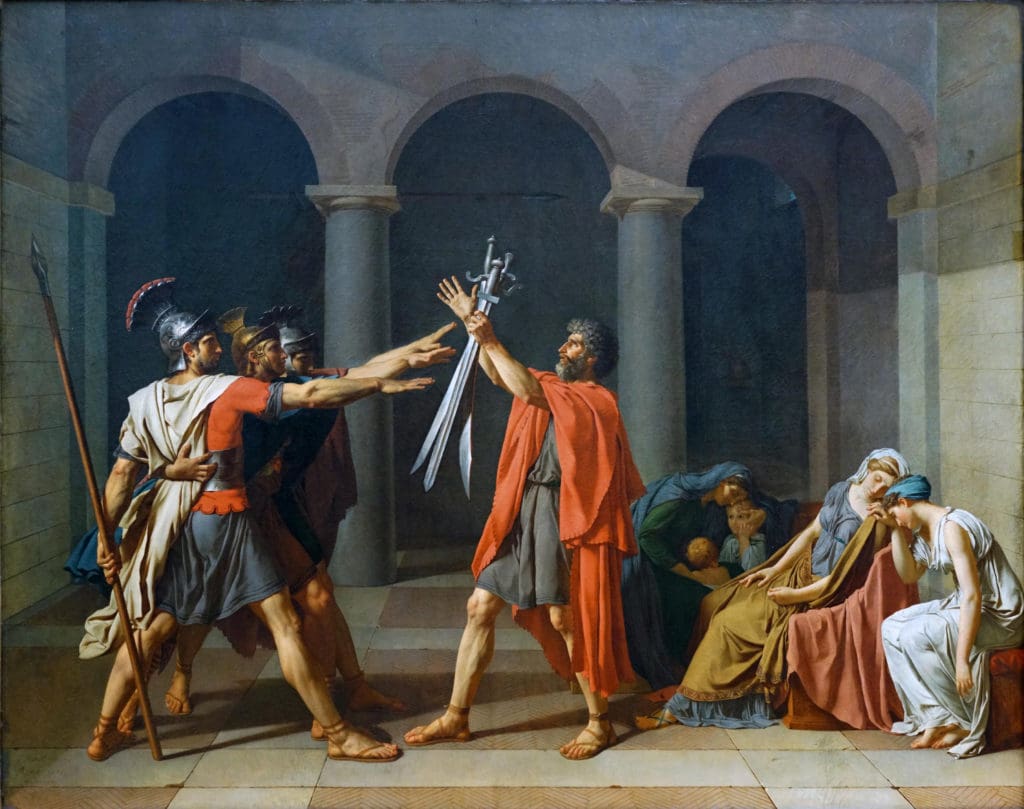
Oath of the Horatii by Jacques Louis David

Oath of the Horatii by Jacques Louis David

What’s the story behind the painting Oath of the Horatii by Jacques Louis David?

  • Roman soldiers and a concocted salute
  • Loyalty and love at war
  • Strident brothers and their despairing sister
Click here for a podcast version of this post.


Like most David paintings, Oath of the Horatii blends truth and fiction. Jacques Louis David based the scene on an historical event. He also inserted a moral to the tale. This was one of his characteristic traits as a painter. Here, David presents pre-Republican Rome through his own eyes. It’s a story of battle between love and tribal fidelity. But conflict wages through several levels in the painting.

First, there are obvious signs of war – armed soldiers. Three stand at the ready. They reach for swords at the canvas center – where their father holds the blades high. These Horatius brothers prepare to fight for their city – Rome. Another trio of brothers plan to meet them in battle. They were the Curatius brothers of Alba. Although these other brothers remain off canvas, they’re present in spirit. That’s thanks to the distraught women at our right in the scene. With these weeping ladies, David reminds us of war’s wreckage.

One of the women, Camilla, was sister to these three Horatii brothers. She cried about losing them. But Camilla was also fiancé to one of the Curatius brothers. Her loss thus expands before our eyes. It’s a resplendent example of how there are no winners in war. Everybody loses. Some lose double, like Camilla. This was Jacques Louis David’s moral, in Oath of the Horatii, beautiful and tragic all at once.

There’s high drama playing out in this scene. So, the painter’s shallow, stage-like space feels right. The soldiers salute their father as they swear an oath to win, or die for their city. Their taut figures and pointed gestures sharpen the scene with suspense. The canvas quakes with a sense of urgency. War beckons with those lifted arms at the ready.

It’s such a powerful and central stance in the painting, this “Roman salute”, that the French took it on. It became popular to perform this gesture in France as David’s painting developed an audience. Still, it’s unclear that Romans actually saluted like this. All recorded history knows for certain is that Jacques Louis David kicked off a trend with Oath of the Horatii. The same fabricated gesture was adopted by the Nazis as a popular salute 150 years later.


Oath of the Horatii by Jacques Louis David

The salute represented loyalty to one’s people at the time -1784. In fact, it’s a rather oblivious brand of fidelity. These brothers see only their swords and the battle that awaits. But high emotions to our right draw viewer eyes to the women in the painting. They weep and languish. In fact, their bodies contrast those of the soldiers. While the men raise their arms in linear, upright, unison, the women slump with drooping arms.

This postural opposition between the Horatii men and women brings us back to the title. The men make an oath here. They stand strident and sure of this pledge. It’s scary but simple sacrifice for the men. Either they win this battle or they die for Rome. Camilla Horatii also made an oath. Hers was to the other side of this imminent battle, though. She had pledged to marry one of their opponents.

Camilla was sister to these three Horatii. The trio are swearing to either kill her fiancé or die while she watches. This explains her deflated figure. Her oath offers no hope. No matter what happens, she loses at least one person she loves. The situation puts Camilla in a helpless position. That’s also opposite of her three brothers. They have choices. Part of why they stand so tall is that they are choosing to go to battle here. They hold their future in hand, as they will grasp and wield their swords. But Camilla’s future is out of her hands. She’s a puddle of fear and despair.

Jacques Louis David creates depth on this emotional side of the painting with color. The woman at this scene’s forefront wears bright white. This matches the headwrap of the next woman. In fact, these two touch heads in a comforting gesture. That points to their closeness, which seems like family. This second woman wears pale, neutral fabric in grey and taupe.

The hues deepen as our eye follows the figures back toward the painting center. In fact, the woman farthest away wears all black. She’s crouched behind the Horatii patriarch. This makes sense because it’s likely this figure represents the mother here. She wears black and crouches lowest in the scene – a symbol of war’s emotional wreckage.


Oath of the Horatii – FAQs

Was Oath of the Horatii the origin point for the Nazi salute?

Yes. Europeans knew this gesture as the “hail Caesar” salute. It was popularized by this painting about four years before revolution gripped France. That was thanks to the painting Oath of the Horatii by Jacques Louis David. The soldiers at canvas center hold their arms high in this salute. At that time it symbolized their undying loyalty to Rome. However, it was only symbolic.

When the Horatii went to battle for Rome, Caesar hadn’t yet been born. Yet, the French people who adopted this gesture knew it as the “hail Caesar” salute. Jacques Louis David created this as part of his dramatic interpretation. In fact, this isn’t David ‘s only historical concoction. Read the story behind his painting Death of Marat for an illustrative example.

Download a pdf of the book about this below, if you’re interested in reading more about this Roman salute and its history.

Who was the patron for Oath of the Horatii?

As with most of Jacques Louis David’s paintings, the monarch commissioned Oath of the Horatii. The king wanted to see what David learned during a five year study sabbatical he spent in Rome. The Louvre palace where the king lived in Paris exhibited this masterpiece in 1784. That’s also where it lives today, now that the Louvre is a museum. It was a successful commission for several reasons.

The painting accomplished the King’s political goal, elevating loyalty to one’s country. It also made David even more famous. Oath of the Horatii created a sensation. This impacted more than just the art world because the salute also became popular among the French.


Enjoyed this Oath of the Horatii analysis?

Check out these other essays relevant to Jacques Louis David artwork.


Martin M. Winkler, The Roman Salute: Cinema, History, Ideology (Columbus: Ohio State University Press, 2009), 54.

Albert Boime, Art in the Age of Revolution: 1750–1800 (Chicago and London: University of Chicago Press, 1987), 400-401.

Roth, Michael (1994). “Facing the Patriarch in Early Davidian Painting”. Rediscovering history: culture, politics, and the psyche. Stanford University Press. 

Jacques-Louis David and Peter Russell (2017). Delphi Complete Works of Jacques-Louis David (Illustrated).

Crow, Thomas (1985). Painters and Public Life in Eighteenth Century Paris. New Haven: Yale University Press

Marvin, Roberta Montemorra; Downing A. Thomas (2006). “Roman Republicanism and Operatic Heroines”. Operatic migrations: transforming works and crossing boundaries (illustrated ed.). Ashgate Publishing, Ltd.

-mother_and_child-Lord_frederic_leighton

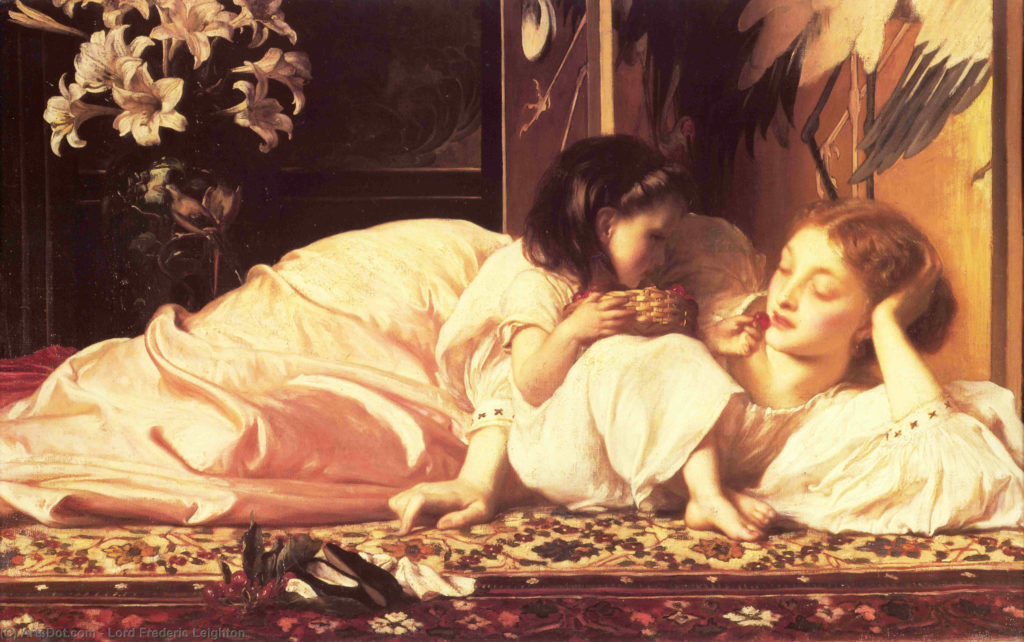
Mother and Child, 1865 by Frederic Leighton


Why is Lord Frederic Leighton’s masterpiece Mother and Child still so popular?

  • Symbolism in lilies, shoes, birds, and a grape
  • When a mother frames your whole world
  • The Baron painter Leighton: rich, famous and still relevant
Click here for the podcast version of this post.


I love the delicate mood of Mother and Child by Lord Frederic Leighton. It gives viewers an insider’s peek at maternal intimacy. There’s a remarkable sensitivity in this portrait. The painter was a grand master of the Victorian period. The Queen loved him and he got famous and rich off his work. But you’ll have a hard time finding much mention of him in most art history texts. Of course, many artists develop popularity and get rich only to end up among the obscure. Leighton’s work remains relevant, though.

Some things stay constant in the world. Technology and innovation may evolve our lives on the surface. But a child feeding her mother a grape stays pure and profound through the ages. In Leighton’s painting Mother and Child we see this tender moment. The child snuggles into the curve of her mother’s arm. It’s a hug. So, we know this child feels loved in the moment. That urges her to give that love back to her mother. The grape she feeds her mother represents that affection.

This warm moment thus shows love as teachable. We learn how to love through loving parents. That’s evident in the way Leighton’s little girl shares the grape. But we also see this with how her mother receives it. There’s palpable comfort and ease between them. The mother relaxes into this, trusting in the moment. That warm reception helps the little girl learn how to be gentle and caring. Children learn by modeling reactions as much as they do actions. So, the mother’s calm manner permeates this masterpiece.


Mother and Child by Frederic Leighton

Academic Art:

This art movement name comes from its origin of style and standards, the French Académie des Beaux-Arts. Academic art blended the traditions of Neoclassicism and Romanticism. These both embraced classic ideals about beauty, realism, and morality. Such works are often enchanting and thoughtful with true-to-life subjects. Painters who fit in this category include Jacques Louis David and Frederic Leighton.

Neoclassicism:

Like many art movements, Neoclassicism was a reaction to another art style. It eschewed the luxurious flamboyance and sensuality of Rococo artworks. They took their disdain a step beyond aesthetics, though. The Neoclassicists believed a more rational and direct approach to art made their work morally superior to romantic Rococo art. They delineated forms with a focus on precision and clarity. Affiliated painters include François Gérard and Jacques Louis David.

Romanticism:

Although often positioned in opposition to Neoclassicism, Romanticism flourished in Jacques Louis David’s studio. Some of the greatest romantic painters, like Jean Auguste Dominique Ingres, trained there. It was ironic because David was an eminent Neoclassicist. Romanticism combines two fundamentals, emotion and the eminence of nature. This makes it easy to spot Romantic paintings from the early 1800s. They portray either emotion, nature’s power, or both.


Mother and Child epitomizes the Academic art style. It blends strong emotional resonance with the distinct clarity of Leighton’s technique. That’s a trademark of the Academic art movement. It combines Neoclassicist realism with the strong feelings of Romanticism. We see this in the masterful way the parent and child connect in the painting. The mother’s body illustrates her role in position and gesture. She fills the entire width of the canvas. Her arms also envelop the child in an embracing frame. That’s how her figure represents the way a parent shapes a child’s entire world.

I also love the subtle way her hand points toward the little girl’s shoes at the front of the painting. It’s as if she’s reminding us that her child has a life outside this moment too. She gives her daughter a warm and comfortable home. But there’s also a world outside. So, this mother must prepare this child for that too. The shoes might not seem a strong enough symbol for this on their own. Then we see the bird on our right on the wall behind her. One day this child will leave and make her own way in the world, like a bird from a nest.


Those lovely flowers to our left tie into this element of parenting as well. All blossoms represent the passage of time because flowers have such a short shelf life. But lilies also symbolize devotion and motherhood. That’s a reference from the Greek myth of Hera and Zeus. So, these flowers Leighton picked create a sublime symbiosis with the style of this painting. They show the painter’s logical intention. Their presence also reveals the sensitivity and care of this mother. She feathered this nest with all the best for her little girl. That’s why her daughter shows so much love to her dear mother in the way she gives her that grape.


Mother and Child – FAQs

Where can I see Lord Frederic Leighton’s Mother and Child painting in person?

Next time you’re in England, visit Blackburn Museum and Art Gallery. It’s on Museum Street in Lancashire and the proud home of this lovely Leighton painting. Call ahead and make sure it’s on display. This museum only exhibits chosen pieces from their rotating collection at any given time.

Why is Mother and Child by Frederic Leighton an important painting?

The delicate beauty, universal theme, and symbiosis of styles make this one of the most popular reproductions on the market. Leighton was also a celebrated artist during his lifetime. In fact, he got rich from painting. This trend continues to this day. Mother and Child isn’t only a beautifully rendered, evergreen subject. It also shows technical mastery, with few to zero visible brushstrokes and stunning clarity.

Why was Frederic Leighton such a popular painter?

Much like a five star, fusion restaurant, Leighton crossed categories with high level skills. His works are an equal pleasure for fans of Romanticism as well as Neoclassicism. That doesn’t just make him an Academic painter. It shows his tremendous dexterity in painting technique, composition, and symbolism. Frederic Leighton taps into our deepest embedded archetypes while wowing us with his gentle mastery.


Enjoyed this Mother and Child analysis?

Check out these other essays on British painters.


Chisholm, Hugh, ed. (1911). “Leighton, Frederick Leighton, Baron”. Encyclopædia Britannica. Vol. 17 (11th ed.). Cambridge University Press.

Visit Leighton House Museum online

Keren Rosa Hammerschlag, “Frederic Leighton: Death, Mortality, Resurrection“, Routledge 2018.

Richard Ormond, Author, Benedict Read, With, Stephen Jones, “Frederic Lord Leighton”, Abrams 1996.

Edited by Tim Barringer and Elizabeth Prettejohn, “Frederic Leighton:Antiquity, Renaissance, Modernity”, Yale University Press 1999.

The-three-Youngest-daughters of George III

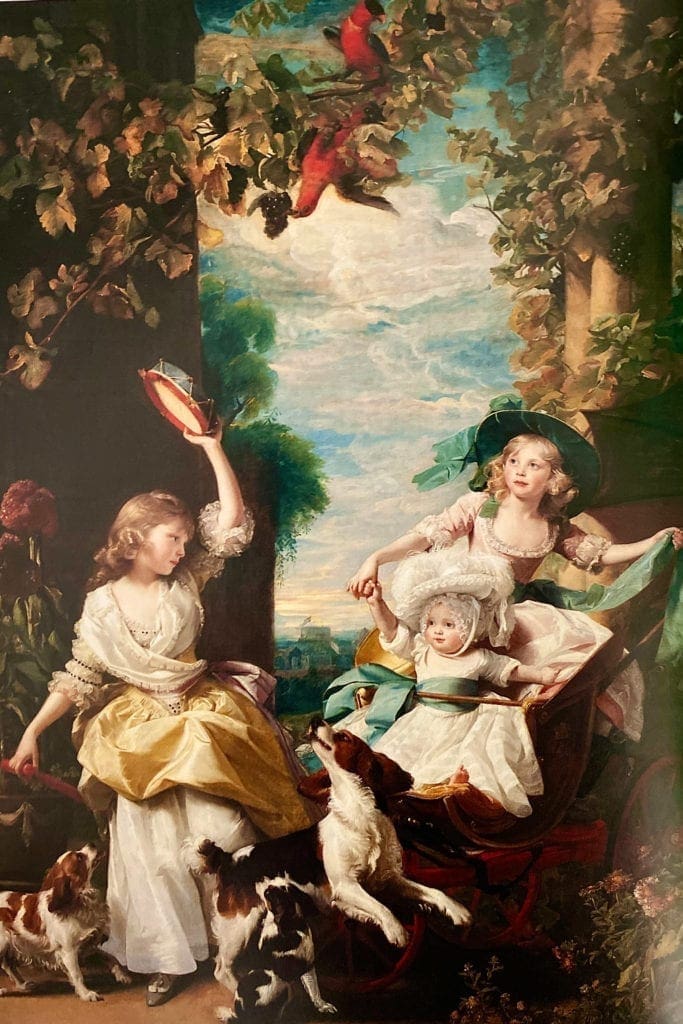
The Three Youngest Daughters of George III by John Singleton Copley

Table of contents for this post on The Three Youngest Daughters of George III.

  • Whoah. King George had how many kids?
  • The Three Youngest Daughters of George III – anything but posers
  • Copley’s red connections

Click for the podcast version of this post.


There’s delight in the details of The Three Youngest Daughters of George III. It starts with the sublime specificity of that title. George III had the most children of any British King in history – 15. So, to be his three youngest daughters was special. Being the baby always is. But after a literal dozen other kids? That’s a peak princess pampering situation. This painting proves that theory too. Of course, all these kids likely contributed to his alleged “madness”. Yes, he’s that King George.


A castle teeming with that many kids abounds with excess. That’s the special sauce in The Three Youngest Daughters of George III. This portrait flourishes with indulgence. John Singleton Copley even frames the trio in multiples. He surrounds all three with a delicate leaf garland. But the American painter also frames each individual child. Princess Mary with the tambourine sets the most obvious example. Copley gives her a solid wall background. She’s the eldest sister and most engaged in her own thing. Mary plays music and pulls the carriage where her sisters sit.


Check out the red handle in her hand. This color connects her with the scene in several ways. Red birds above sing along with her scarlet tambourine. Also, Mary’s sisters ride in the red-wheeled cart. She leads with this guiding hand and her music. Mary’s younger sisters wear face framing hats. The elder of the two, Sophia, also holds baby Amelia’s, hat ribbon. She pulls it to the side. Thus, Sophia takes charge of framing her sister within the portrait as well.


The Three Youngest Daughters of George III

Copley’s Balance of Chaos

But the best part of this painting sits at the bottom. The three royal Springer Spaniels enliven this already chaotic painting. Copley captures two of them in motion. This adds puppy energy to the scene’s already charming disorder. The Three Youngest Daughters of George III also resonates family connection. So, this combination of chaos and harmony balances the scene. Three dogs parallel a trio of sisters. Copley sets them in a space that straddles indoor and outdoor areas as well. This grounds the girls in the real world. They’re not fairytale princesses hidden away in a castle.


That’s the grandest privilege in this piece. These young children didn’t have to pose – motionless. They’re more real to us thanks to that. Most portraits, even of children, from the 1700s were much more formal. It’s part of why kids seem more like adults in those paintings. They had to fake it and force expressions to suit the artist over many sessions. This practice robs subjects of spontaneity. But these three children have the natural ease of a photograph. Their soft curls appear to dance. Baby Amelia seems to react to Mary’s tambourine. Sophia sways to the beat. It’s a gentle action scene and extraordinary feat for an 18th century oil painting.


Still, The Three Youngest Daughters of George III epitomizes the era. 1785 was the peak of Neoclassicism in Western painting. This masterpiece delights viewers with a perfect example of the style. Neoclassicist paintings share three main attributes. They portray classical subjects in a linear manner. Neoclassicism also harkens to Greek and Roman antiquity with its priorities. That means, clarity, harmony, and restraint with idealism.


But the most Neoclassicist aspect of this portrait is archeological accuracy. It also heightens the pull of this painting. We’re drawn in by the spectacle and material details. After all, most people would love a chance to peek behind the curtain into a royal household. Add a baby and puppies to the mix and you’ve got a hit on your hands. Best of all, John Singleton Copley draws it still further. His sensitive, individual takes on each child and keen specifics draw us into the scene. It feels like we’re there. As much as it’s extravagant, Copley also keeps it real in this masterpiece.


The Three Youngest Daughters of George III – FAQs


Where can I see Copley’s The Three Youngest Daughters of George III in person?

You might think that this royal painting is only for British royal eyes. But even I, an American plebeian, have seen it in person. In the early 1990’s this painting featured in a University of Virginia exhibit. High Style and Vernacular Art: Art for Americans in the Age of Jefferson (1750 – 1850) opened my eyes. Through this show, I started to understand the importance of archeology in artwork. If viewers notice specific materials in the painting, they may interpret the meaning that artists wish to convey.

Viewers can also often see The Three Youngest Daughters of George III in England. For instance, there was a showing in 2014 thanks to a Royal Collection Trust exhibit. Art exhibits like this one help make Buckingham Palace seem a bit more approachable. But they also remind viewers of the alien and imperious lifestyles of royals – even as children. The Royal Childhood show as well as the UVA exhibit both featured work by another of my favorite painters, Benjamin West.


Who are the princesses in The Three Youngest Daughters of George III?

These three girls grew up in the shadow of their father, King George III’s, madness. Of course, there’s not a hint of this trauma in the painting. But we know from history how George III suffered. Doctors continue to debate with what, though. They all agree that his illness presented as mental. Still, it could have been a blood disorder that made him act this way. We may never know its true cause with certainty. What’s clear, though, is that his wild behavior impacted his family.

For instance, the King and Queen over-protected their daughters. They didn’t want them to marry. The youngest daughter, Amelia was just a baby in The Three Youngest Daughters of George III. She also died young from TB. Before her death she fell in love and wished to marry. But the royal couple didn’t approve and she died unwed. Her older sister, Sophia, also didn’t marry. She’s the one holding Amelia’s ribbon in the painting. But Tambourine Mary did have a chance to wed. Too bad it was to her cousin, Prince William Frederick, Duke of Gloucester and Edinburgh. Also, Mary was his second choice after his proposal to her older sister Charlotte didn’t work out.

For more gruesome and glorious stories about all six daughters of George the third, check out The Daughters of George III: Sisters and Princesses. It’s a fantastic book by Catherine Curzon. One of the sisters inspired a character in the Netflix series Bridgerton. So, you know this book’s got drama.


Why did a British King choose an American painter for a royal portrait?

John Singleton Copley was an extraordinary portrait painter. He moved to England while the American Revolution brewed in Boston Harbor. But before leaving with his Tory wife, Copley made a name for himself in American portraits. These include the formidable Paul Revere.

England knew about his mastery even before he moved to England. That’s because his portrait A Boy with a Flying Squirrel had already made a splash there. Copley’s painter buddy, Benjamin West got this gorgeous piece into the British exhibition of the year – 1766. It created such a buzz that Copley got oodles of letters urging him to move across the pond.

Such invitations continued in earnest. So, after marrying into a Tory family, he answered the call and moved to England in 1774. Copley then honed his craft while traveling across Europe and painting beloved portraits. This built his reputation over the next ten years until he reached the pinnacle and painted The Three Youngest Daughters of George III for the King in 1784. He finished this masterpiece in 1785.


Enjoyed The Three Youngest Daughters of George III analysis?

Check out these other essays on American Painters.


Kelso, Paul (6 March 2000). “The royal family and the public purse”. The Guardian

See The Three Youngest Daughters of George III at the Royal Collection Trust

Flexner, James Thomas (1948). John Singleton Copley. Boston: Houghton Mifflin

Macalpine, Ida; Hunter, Richard A. (1991) [1969]. George III and the Mad-Business. Pimlico

Hadlow, Janice (2014). A Royal Experiment: The Private Life of King George III. Henry Holt and Company

Rebora, Carrie; et al. (1996). John Singleton Copley in America (PDF). New York: Metropolitan Museum of Art

Amelia according to the Royal Collection Trust

Curzon, Catherine (2020), The Daughters of George III: Sisters and Princesses, Pen and Sword History

Scroll to Top